An office desk holds four hundred times more bacteria than a standard toilet seat. That is not a figure most facility managers think about until half their team calls in sick during flu season.
Dr. Charles Gerba at the University of Arizona found over ten million bacteria on the average desktop. Office phones carry twenty-five thousand germs per square inch. Computer keyboards hold seventy percent more micro-organisms than restroom porcelain. These numbers climb by nineteen to thirty-one percent over a single workday without routine sanitation.
The solution is not complicated. Daily disinfectant wiping removes ninety-nine point nine percent of surface bacteria. A structured commercial cleaning schedule cuts absenteeism in half and raises productivity by twelve percent. But the schedule only works if the frequency matches the building, and that is where most facilities get it wrong.
What factors set office cleaning frequency?
There are four main variables that shape the cleaning schedule for any commercial property. They are foot traffic volume, occupant density, spatial function, and floor material types. High-occupancy corporate facilities with more than two hundred daily occupants require daily janitorial care. Low-density administrative suites under fifty occupants maintain baseline hygiene through two or three scheduled service visits per week.
The core operational factors controlling cleaning cadences include:
- Occupant Density and Foot Traffic: High foot traffic speeds up soil accumulation and pathogen cross-contamination across shared spaces. Facilities hosting over five hundred visitors each day demand deep carpet extraction every six to eight weeks, compared to annual cycles for low-traffic sites.
- Facility Function and Spatial Risk: Food preparation zones, medical offices, and restrooms require daily or twice-daily sanitation cycles due to biological hazard loads. General administrative spaces operate on standard daily high-touch wipes.
- Flooring Material and Fabric Types: Synthetic carpet tiles collect dust particles that demand daily HEPA vacuuming and quarterly hot-water extraction. Hard floor surfaces like vinyl composition tile or polished concrete require daily dust mopping and damp mopping.
- Regulatory and Compliance Standards: Healthcare offices and food service facilities must comply with explicit work health and safety sanitation mandates. Standard corporate suites align with ISSA Level 2 cleanliness guidelines.
What is the master facility cleaning cadence schedule?
Commercial facilities require a structured cleaning schedule that divides tasks into daily recurring passes, weekly detail resets, and monthly or quarterly deep maintenance. High-touch surfaces and wet zones need daily interventions, while overhead structures and floor restoration operate on periodic cycles.
| Facility Zone | Daily Recurring Cadence | Weekly Detail Reset | Monthly or Quarterly Deep Service |
| Reception and Entrance Lobbies | Empty waste bins, spot clean glass, sanitize door handles, vacuum entrance mats, damp mop hard floors. | Polish internal glass partitions, wipe skirting boards, dust baseboards. | High dust fixtures above two meters, hot water extract carpets, burnish hard floors. |
| Workstations and Open Desks | Empty desk bins, wipe clear desk surfaces, sanitize computer mice, keyboards, and phone handsets. | Vacuum edge to edge under furniture, wipe chair bases and castors, dust cable trays. | Deep extract fabric desk chairs, vacuum fabric partition panels, sanitize interior storage drawers. |
| Meeting and Conference Rooms | Sanitize table surfaces, wipe AV touchscreens and remotes, reset seating, vacuum high traffic lanes. | Dust picture frames and sills, clean credenza interiors, polish wooden conference tables. | Vacuum overhead supply vents, spot clean wall smudges, hot water extract main carpets. |
| Breakrooms and Kitchens | Sanitize counters and tables, scrub sinks, clean microwave interiors, empty trash, mop hard floors. | Deep clean microwave walls, wipe cabinet faces, descale sink faucets, flush floor drains. | Sanitize interior refrigerator walls, degrease behind appliances, apply biological drain treatments. |
| Restrooms and Amenities | Sanitize toilets and urinals, descale basins, polish mirrors, restock paper and soap, damp mop floors. | Wipe full wall tiles, scrub cubicle door partitions, descale shower fixtures. | Machine scrub floor tile grout lines, deep acid descale porcelain bowls, flush main drains. |
Running a master schedule follows a structured sequence rather than a random sweep. Cleaning technicians move from clean administrative zones toward dirtier washroom facilities to prevent biological migration. Within individual rooms, work progresses from top to bottom, letting dislodged dust fall to the floor before vacuuming or mopping. Technicians use clockwise perimeter paths to make sure they do not miss any corners or fixtures. Under standard operational rules, minor spot cleaning tasks taking under three minutes are handled during active passes, while thirty minute restoration tasks are logged for periodic maintenance shifts.
A common failure point occurs when a night cleaner wipes a toilet bowl and then walks straight into the breakroom using the same cloth to wipe down a lunch table. That is the exact moment cross contamination happens, which is why clear spatial boundary rules matter far more than chemical selection alone.
What are ISSA cleaning times and labor staffing benchmarks?
ISSA production standards establish that one full time equivalent janitorial worker can maintain twenty-five to thirty-two thousand square feet of standard commercial office space per eight hour shift under Level 2 cleanliness parameters. Healthcare and clinical spaces require tighter staffing ratios, covering twelve to eighteen thousand square feet per full time worker due to strict infection control demands. Always run the actual task numbers before signing a vendor contract. Otherwise, the facility will end up understaffed and essential tasks will slip.
| Cleaning Task Description | Equipment Used | ISSA Productivity Rate | Standard Time Required |
| Upright Carpet Vacuuming | Commercial Upright HEPA Vacuum | 3,000 to 4,000 sq ft per hour | 15.0 to 20.0 minutes per 1,000 sq ft |
| Backpack Carpet Vacuuming | Commercial Backpack HEPA Vacuum | 5,000 to 8,000 sq ft per hour | 7.5 to 12.0 minutes per 1,000 sq ft |
| Manual Hard Floor Mopping | Flat Microfiber Mop and Bucket | 2,500 to 3,500 sq ft per hour | 17.0 to 24.0 minutes per 1,000 sq ft |
| Walk Behind Autoscrubbing | 20 Inch Walk Behind Scrubber | 15,000 to 25,000 sq ft per hour | 2.4 to 4.0 minutes per 1,000 sq ft |
| Ride On Autoscrubbing | Large Ride On Automatic Scrubber | 40,000 to 70,000 sq ft per hour | 0.8 to 1.5 minutes per 1,000 sq ft |
| Restroom Fixture Sanitation | Sprayer, Cloths, Bowl Brush | 15 to 20 minutes per restroom | 3.0 minutes per fixture |
| Trash Collection and Relining | Janitorial Cart and Bin Bags | 8 to 12 seconds per container | 0.13 to 0.20 minutes per container |
| High Touch Disinfection Pass | Microfiber Cloth and Disinfectant | 1,000 to 2,000 sq ft per hour | 30.0 to 60.0 minutes per 1,000 sq ft |
How do you run a seven step sequential room cleaning workflow?
Standardizing room cleaning passes into a sequential seven step workflow ensures predictable service delivery across facility sites.
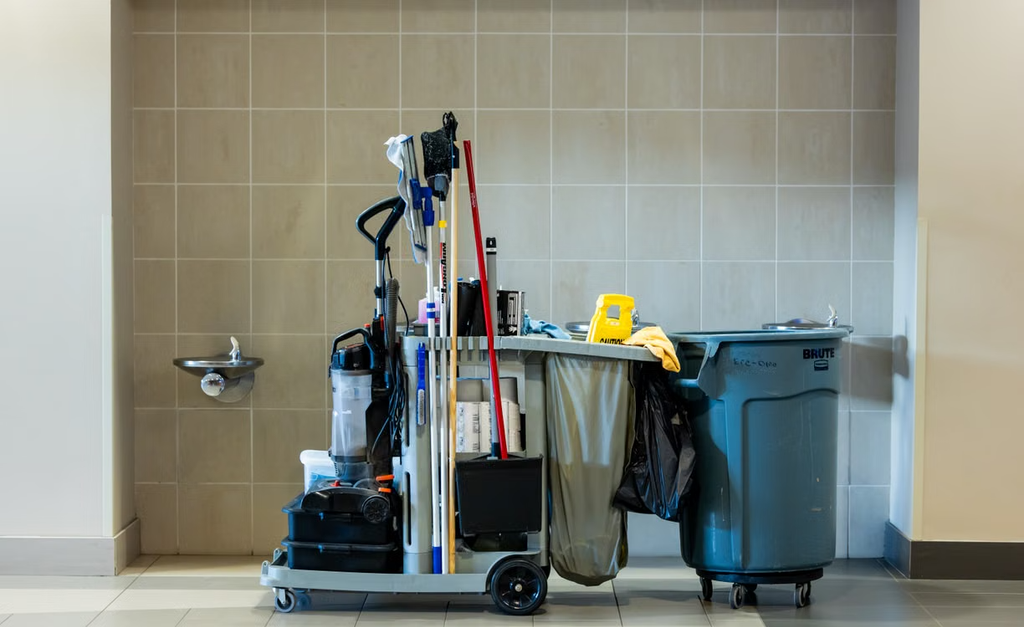
- Preparation and Hazard Assessment: Technicians stage color coded cloths, chemical solutions, protective gear, and HEPA vacuums on a janitorial cart. They set up safety signs at access doors and inspect the area for broken glass or open wiring.
- Waste Collection and Receptacle Maintenance: Technicians empty general waste, organic compost, and recycling bins. They wipe down interior and exterior bin touchpoints with detergent, replace liners with correct bag sizes, and process waste streams.
- High to Low Dry Dusting: Using extension wands and electrostatic microfiber dusters, technicians clear dry particulate soil from ceiling vents, light diffusers, door frames, window sills, and monitor backs.
- Detergent Cleaning and Surface Soil Removal: Technicians apply neutral detergent spray to blue microfiber cloths to remove grease, fingerprints, and dirt from desks, conference tables, sideboards, and glass partitions.
- Targeted High Touch Disinfection and Dwell Time Execution: Hospital grade disinfectant is applied directly to door handles, light switches, keypads, elevator buttons, phone handsets, and shared touchscreens. The solution remains visibly wet on the surface for the full manufacturer specified dwell time of two to ten minutes.
- Zone Specific Wet Cleaning and Appliance Care: Technicians handle wet cleaning in breakrooms and washrooms. They scrub microwave interiors, descale kitchen taps, scrub toilet bowls from clean outer porcelain to inner rims, and polish chrome fittings.
- Floor Care, Quality Audit, and Verification: Technicians vacuum carpets and damp mop hard floors starting at the furthest corner and working backward toward the door. Once complete, they conduct a visual glare inspection, run an audit verifying that all scoped tasks match site service agreements, secure access doors, and log completion in the site log so nothing gets missed.
Facility managers often fail to recognize that a carpet is being vacuumed with a worn out brush roll until traffic lanes turn grey and permanent fiber matting sets in. Keeping an eye on equipment wear is just as vital as managing cleaning schedules.
How do you prevent cross contamination with color coding protocols?
Cross contamination occurs when cleaning tools mechanically transfer pathogens from dirty surfaces to clean zones. Facilities implement visual color coding frameworks aligned with professional cleaning standards to isolate contamination risks.
| Color Standard | Assigned Operational Zone | Equipment Scope | Biological Control Objective |
| Code Red | Toilet Bowls, Urinals, Washroom Floors | Red cloths, mops, buckets, gloves | Isolates high risk fecal pathogens and urine residues inside restroom boundaries. |
| Code Blue | Desks, Lobbies, Offices, Hallways | Blue microfiber cloths and dusters | Removes dirt and skin flora from low risk administrative surfaces without scratching finishes. |
| Code Green | Kitchens, Cafeterias, Food Prep Counters | Green cloths, mops, food safe sanitizers | Prevents office dust and restroom pathogens from reaching food contact surfaces. |
| Code Yellow | Washroom Sinks, Locks, Mirrors, Tiles | Yellow cloths, sponges, light descalers | Separates sink and tap cleaning from high pathogen toilet porcelain zones. |
Microfiber cloths feature split synthetic fibers measuring under ten micrometers that create electrostatic charges and capillary action, trapping ninety-nine percent of surface dirt and microbes. Technicians fold each cloth into quarters, creating eight fresh working faces. Wiping with one clean face per surface pass prevents re tracking dirt. Used cloths are laundered in color segregated loads at sixty to ninety degrees Celsius using neutral detergent. Fabric softeners and bleach are left out because they clog synthetic channels and destroy fiber charges.
What is the commercial carpet maintenance cadence?
Professional standards specify that commercial carpet cleaning schedules depend directly on daily traffic counts, indoor climate, and soil loads. Daily HEPA vacuuming extracts abrasive surface soil before foot traffic grinds particulates into secondary carpet backing.
| Traffic Classification | Daily Foot Traffic Volume | Professional Extraction Cadence | Service Life Impact |
| Light Foot Traffic | Under 50 occupants per day | Every 6 to 12 months | Preserves fiber integrity; extends carpet life to 12 to 15 years. |
| Moderate Foot Traffic | 50 to 200 occupants per day | Every 3 to 6 months | Prevents traffic lane matting and sub surface soil buildup. |
| Heavy Foot Traffic | 200 to 500 occupants per day | Every 1 to 3 months | Removes deeply embedded oils; prevents permanent fiber crushing. |
| Very Heavy Traffic | 500 plus occupants per day | Every 4 to 8 weeks | Maintains color clarity and stops premature backing deterioration. |
Prompt spot cleaning prevents liquid spills from forming permanent stains. Unmaintained commercial carpets suffer irreversible fiber crushing and require total replacement within five to seven years. Implementing a scheduled maintenance program extends carpet service life to ten or fifteen years, saving facility owners substantial capital expenditure over time.
How do chemical safety standards and quality audit frameworks work?
Work safety rules mandate that all commercial cleaning chemicals conform to standard global hazard criteria. Janitorial closets must hold current safety data sheets for every formulation on site. Secondary spray bottles must display compliant workplace labels identifying chemical names and health hazard warnings.
Chemical disinfectants require strict adherence to dwell times. Disinfectants applied to surfaces must remain wet for two to ten minutes to break down bacterial cell walls. Wiping a wet surface immediately neutralizes germicidal action and leaves live pathogen colonies intact. Acid descalers must never be mixed with sodium hypochlorite bleach, as combining them releases deadly chlorine gas.
Quality assurance relies on visual checks and bioluminescence testing. Management guidelines mandate that supervisors inspect a minimum of ten percent of facility square footage after every shift, supplemented by full monthly inspections. Visual audits use shallow angle lighting to detect streaks, films, and dust. Swab meters offer objective biological metrics in relative light units, confirming that target surfaces meet sanitization thresholds so you can see what was done and when. Digital logging applications record real time entry timestamps, audit scores, and task verification to eliminate operational gaps.
In commercial cleaning, the structure of the maintenance schedule matters just as much as the individual holding the cloth. Without strict protocols, even the most dedicated team will miss critical hygiene steps.
Related Topics
- Commercial Carpet Care Standards: Learn the best practices for extending commercial textile life through routine deep extraction, effective spot treatment, and proactive brush roll maintenance.
- Green Cleaning Solutions: Explore methods for transitioning to eco friendly chemical formulations without compromising germ control standards or causing employee respiratory issues.
- Workplace Wellness and Indoor Air Quality: Understand how managing particulate matter through structured cleaning schedules can drastically reduce allergen triggers and improve overall office productivity.
Frequently Asked Questions
What is the most effective way to eliminate desktop bacteria?
Wiping your desk daily with a disinfectant and a clean microfiber cloth knocks out ninety-nine point nine percent of the germs living on computer mice, keyboards, and phone handsets.
How often should high touch areas be sanitized?
High traffic zones like door handles, light switches, and elevator buttons need attention at least once a day, or multiple times daily if you manage a packed office building.
Why are microfiber cloths preferred over standard cotton rags?
Microfiber cloths use tiny split synthetic fibers that hold a natural electrostatic charge, letting them grab and trap ninety-nine percent of surface dirt and bacteria instead of pushing it around like a standard cotton rag.